
Recent Publication of Australian Carp Book
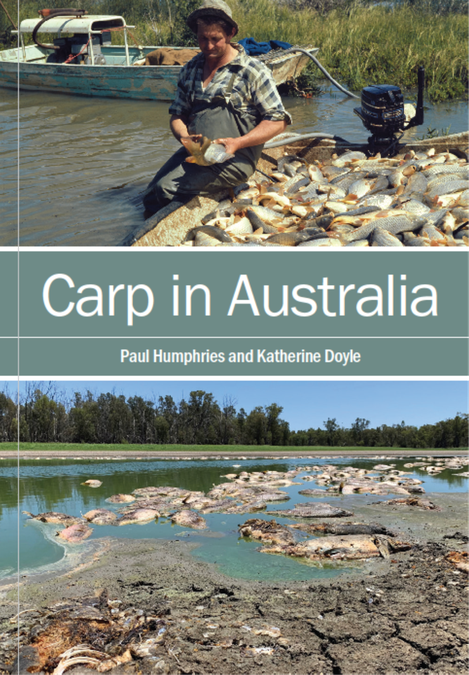
When carp were first brought to Australia in the mid‑1800s, few could have imagined the legacy they would leave behind. Imported for ornamental ponds and recreational angling, carp initially seemed harmless. But once they escaped into natural waterways — first across Gippsland and later throughout the Murray–Darling Basin in the 1960s — their impact was anything but.
Highly adaptable and fast‑spreading, carp quickly established themselves as dominant inhabitants of inland rivers, lakes, and wetlands. Today, they are widely regarded as one of Australia’s most destructive freshwater pests, profoundly altering ecosystems and challenging fisheries managers nationwide.
A newly released book, Carp in Australia, tells this story in full. Drawing together decades of research and on‑the‑ground experience, the book traces how — and why — carp became so widespread, maps their expansion across the Murray–Darling Basin, and examines the ecological consequences for Australia’s freshwater systems. It also explores the long history of carp management, from traditional control measures to more controversial proposals, offering rare insight into the complexity of tackling an entrenched pest.
A Rare Success Story
Among the book’s standout chapters is Chapter 9, which documents one of the few carp eradication success stories in Australia: the 28‑year campaign led by Tasmania’s Inland Fisheries Service (IFS) to eliminate carp from Lakes Sorell and Crescent.
This chapter chronicles a painstaking, long‑term effort that demanded persistence, innovation, and unwavering commitment. The interconnected lakes presented enormous challenges, yet through sustained effort and careful management, carp were ultimately eradicated. The story has since become one of the clearest and most inspiring examples of successful freshwater pest eradication in Australian history.
An Insider’s Perspective
Adding further depth to the book is the unique perspective of its lead author, Associate Professor Paul Humphries. Early in his career, Humphries served as a Scientific Officer with the Inland Fisheries Service (then the Inland Fisheries Commission) from 1991 to 1995 — precisely when carp were first detected in Lakes Sorell and Crescent. His firsthand involvement, combined with decades of ecological research, enriches the narrative with authenticity and firsthand insight.
Why This Book Matters
Carp in Australia is more than a historical account. It is a vital resource for understanding the past, present, and future of carp management in this country. By shining a spotlight on both failures and rare successes, it underscores the realities of invasive species control — and the extraordinary dedication required to achieve lasting results.
In doing so, the book pays well‑deserved tribute to the persistence and resolve that made Tasmania’s carp eradication effort a landmark achievement in Australian freshwater conservation.
