
Little Pine Lagoon Showing Positive Signs of Recovery
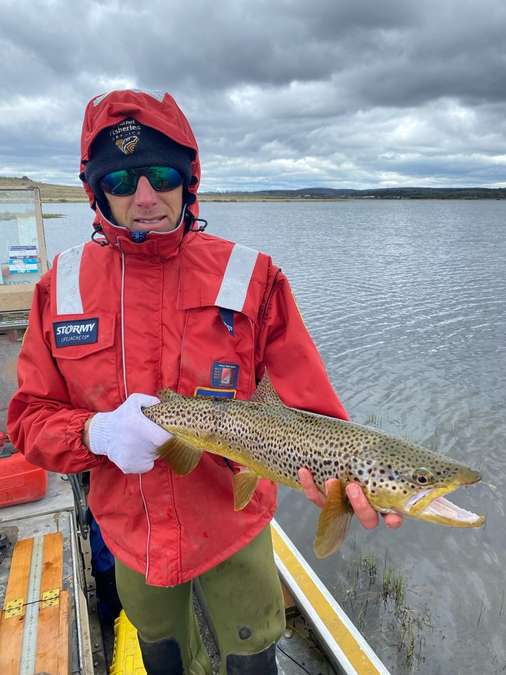

Little Pine Lagoon has in the past been regarded as one of Tasmania's premier dry-fly fisheries, famous for its mayfly hatches, challenging sight-fishing opportunities and quality brown trout. The latest Inland Fisheries Service (IFS) electro-fishing survey has provided encouraging signs that the fishery is beginning to recover following several challenging years.
The survey, completed in early November 2026, forms part of an ongoing program of annual boat electro-fishing assessments undertaken by the IFS. By sampling a wide range of habitats throughout the lagoon, including the inflow areas, fisheries biologists have been able to build a detailed picture of the current status of the brown trout population.
Signs of Improvement After a Difficult Period
Survey results show the brown trout population has improved compared to 2025. Catch rates from the 2026 survey (catch per unit effort [CPUE] of 18.6 fish per hour) were higher than those recorded during the previous year, representing a significant improvement in abundance. While catches remain below levels recorded during the early 2000s (CPUE ranging between 26.5 and 37.5 fish per hour), the 2026 result indicates the fishery is moving in a positive direction.
Importantly for anglers, the survey captured numerous larger brown trout weighing between 1.2 and 1.9 kilograms. These fish were in excellent condition, reflecting strong growth and a healthy food supply within the lagoon.
One of the key findings from the survey was the presence of a noticeable gap in the population's size structure. Very few trout were recorded between 160 mm and 370 mm in length. The absence of these intermediate-sized fish suggests that recruitment was severely affected during 2023 and 2024. This pattern is consistent with the period when unusually large numbers of cormorants were present across several Central Plateau waters, particularly Little Pine Lagoon. Many anglers observed these birds actively feeding within the lagoon and their impact is believed to have contributed to reduced survival of juvenile trout during that period.
The encouraging news is that the cormorant influx has now largely subsided. With predation pressure reduced, the trout population appears to be responding, and the survey results suggest natural population recovery is underway.
Strong Recruitment Provides Optimism
Perhaps the most encouraging result from the 2026 survey was the presence of a strong cohort of young brown trout around 140 mm in length. These fish represent the next generation of Little Pine Lagoon trout and provide confidence that the fishery has the capacity to rebuild naturally over coming seasons.
While anglers may continue to experience lower catch rates in the short term compared with historical highs, the presence of both healthy larger fish and strong juvenile recruitment is exactly the combination we hope to see following the population setback.
The encouraging news is that the cormorant influx has now largely subsided. With predation pressure reduced, the trout population appears to be responding, and the survey results suggest natural population recovery is underway.
Improving Habitat Conditions
The recovery of the fish population is being accompanied by observed improvements in habitat quality throughout the lagoon.
Native aquatic weed beds (macrophytes beds) appear to be expanding and are becoming a more prominent feature. These beds perform an important ecological role by providing habitat for aquatic insects and shelter for juvenile trout. For fly fishers, this development is particularly significant with aquatic vegetation supporting many aquatic invertebrates, including the mayflies for which Little Pine Lagoon is famous.
Looking Ahead
Although Little Pine Lagoon fishery has experienced a difficult few years, the latest survey results provide genuine reasons for optimism. Larger trout remain in excellent condition, a strong year class of juvenile fish is evident, cormorant impacts have diminished and there are signs that important aquatic habitats are expanding.
Taken together, these indicators suggest the lagoon is slowly but steadily returning to the productive and highly regarded fishery that Tasmanian fly fishers know so well.
